The short answer: grayshirt, redshirt, blueshirt and greenshirt
A grayshirt delays full-time enrollment until the January term. You commit to the program, sit out the fall on your own, then enroll, join winter workouts and spring practice, and play your first season the next fall. The name comes from football, where almost every grayshirt offer is made.
The four "shirt" terms describe when you enroll and whether you are on the team. None of them is an official NCAA term, and two of them matter much less than they did a few years ago.
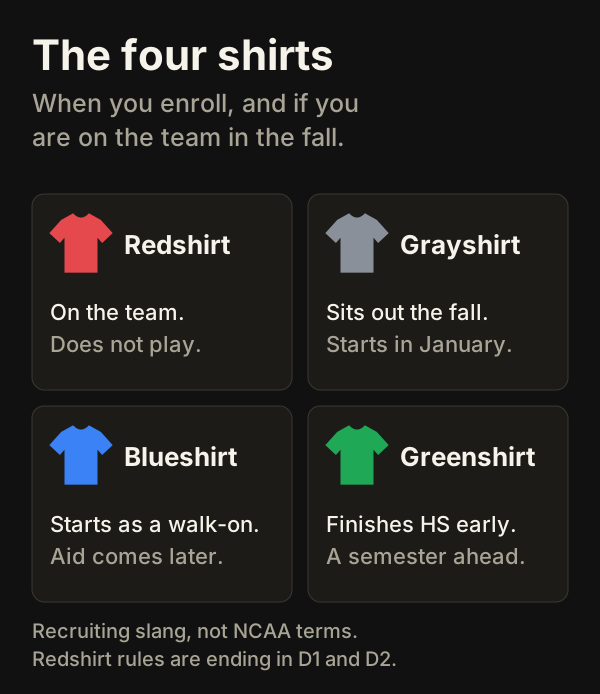
| Term | What it means | On the team in the fall? | Status in 2026-27 |
|---|---|---|---|
| Redshirt | Enrolled full time and practicing, but not competing, to save a season | Yes | Being phased out in Division I and II. Still saves a season in Division III, the NAIA and junior college |
| Grayshirt | Commits, then enrolls full time in January instead of the fall | No | Still used, mostly in football, to fit players under roster limits |
| Blueshirt | Arrives as a walk-on and goes on scholarship after practice starts | Yes | Rare. The class-size limit it worked around ended in October 2023 |
| Greenshirt | Graduates high school in December and enrolls a semester early | Joins in January, before their class | Common for football recruits who can finish high school early |
How a grayshirt year works
The fall is the hard part. You are living at home or near campus, training alone and paying your own way while your class plays. Ask the coach exactly what contact you will have with the staff and strength coaches during those months, because under the rules you are not a member of the team yet.
- 1You commit. The coach tells you the fall roster is full and offers you a spot starting in January.
- 2Your class signs and reports in the summer. You do not. You are not on the roster, so you cannot practice, lift with the team, sit in meetings or travel.
- 3In the fall you train on your own. You can take classes part time, at that college or another one, and you pay for them yourself.
- 4In January you enroll full time, sign your athletic aid agreement if aid is part of the offer, and join winter workouts and spring practice.
- 5You play your first season the following fall, alongside the class that signed a year after you.
Why coaches offer a grayshirt in 2026
The old reasons are gone. Football programs used to be limited to 25 new scholarship players a year and 85 on scholarship in total, and a grayshirt pushed a recruit into the next year's count. The Division I Council permanently eliminated the 25-player annual limit in October 2023. Then the House settlement, approved on June 6, 2025, replaced scholarship limits with roster limits at participating schools.
The new reason is the roster limit. A football team at a House settlement school can carry 105 players, and everyone who takes part in team activities after the roster deadline has to be on that list. Baseball is capped at 34, softball at 25 and basketball at 15. A coach who likes 110 players has to tell five of them something, and "come in January" is one of the things he can say.
January works because rosters turn over in December. Seniors finish, players transfer and a few leave school, so spots open at midyear that did not exist in August. A midyear enrollee still has to fit on the roster, which is why a grayshirt promise depends on who leaves.
See every Division I roster limit
Roster limits by sport at House settlement schools, next to the scholarship limits they replaced, plus what happened to walk-ons.
What a grayshirt does to your five-year clock
Division I adopted an age-based eligibility model on June 23, 2026, and Division II followed for 2026-27. You get five years to compete. The clock starts at the earlier of two moments: your first term as a full-time college student, or the start of the academic year after your 19th birthday. Students who first enroll full time in fall 2027 or later are under this rule only.
For most grayshirts that is good news. In Division I, a first full-time enrollment between November 1 and May 1 starts the five-year period with the spring term. A student who first enrolls full time in spring 2027 stays eligible through the fall 2031 term, which covers five fall seasons.
Age is the catch, and almost no page ranking for this term mentions it. If you turn 19 before September 1 of the fall you sit out, your five years start that fall anyway. You would spend the first semester of your clock training alone at home. If you turn 19 on or after September 1, the age trigger moves to the following fall.
| Your situation | When the five years start | What the grayshirt fall costs you |
|---|---|---|
| 18 for the whole fall, not enrolled or part time | The January term you enroll full time | Nothing on the clock |
| Turn 19 on or after September 1 of that fall | The January term you enroll full time | Nothing on the clock |
| Turned 19 before September 1 of that fall | That fall, even though you are not enrolled | A fall season of your five years |
| Enroll full time anywhere in the fall, including a junior college | That fall term | It is no longer a grayshirt; the clock is running |
Older for your grade? Read how reclassifying interacts with the age rule
What is in writing, and what is not
A grayshirt offer is verbal. The National Letter of Intent was eliminated in October 2024, and what a recruit signs now is a written athletic aid agreement. Until you sign one, the school is not bound to you and you are not bound to the school. For a grayshirt, that signature usually comes around January enrollment, months after your classmates signed.
That gap is the risk. A coaching change, a transfer who takes your spot, or a recruit the staff likes better can all happen between August and January. It also works the other way: a fall offer can turn into a grayshirt request late. In 2015 Louisville asked a committed running back to grayshirt about 48 hours before signing day, after most other programs had filled their classes.
- Ask when you would sign the athletic aid agreement, and whether you can sign it before the fall.
- Ask what the January offer is in dollars, and for how many years.
- Ask how many players the staff expects to leave in December, and what happens to you if they do not.
- Ask whether the offer survives a coaching change, and get the answer from the head coach.
- Ask compliance, not just the coach, whether your birthday starts your clock that fall.
My take: a grayshirt offer tells you where you are on the board
I read a grayshirt offer as honest information. The coach wants you, and he wants the players he gave fall spots to a little more. That is worth knowing in August instead of finding out on the depth chart.
What I would not do is stop recruiting. Until an aid agreement is signed you are a free agent with a promise, and a January promise from one staff is worth less than a fall roster spot from another. Keep emailing coaches at programs where you would be in the fall plan, tell them plainly that you have a January offer, and see who moves. In our platform data, athletes who email 50 or more coaches hear back 82% of the time. Options are what make a grayshirt a choice.
If you do take it, treat the fall like a job. Get the strength program in writing, take two part-time classes that transfer, and check in with the staff every couple of weeks so January is not the first time they have thought about you since July.
Get a fall roster spot on the table
NextCommit builds your coach list, writes a personal email to each coach from your stats and film, sends from your own inbox and tracks every reply. 7-day free trial.
Grayshirts outside Division I football
- Other Division I sports: the mechanics are the same, but the offer is rare. Wrestling is the main exception, where some recruits, mostly at Ivy League programs, spend a year training without enrolling.
- Division II: the same five-year period and the same two triggers apply for 2026-27.
- Division III and the NAIA: both count semesters of full-time enrollment (10 semesters), so a fall you are not enrolled does not use one.
- Junior college: the NJCAA allows two seasons per sport, and playing in any part of a game uses one. Remember that full-time junior college enrollment starts the NCAA five-year clock.
Written by
Adam Paganelli
Co-founder, NextCommit
Adam Paganelli is a co-founder of NextCommit. He played college baseball at Green River College, Sacramento City College, and Northwest Nazarene University after graduating from Tahoma High School in 2018, and he builds the AI outreach, Recruit Score, and coach database tools athletes use on NextCommit.
- Co-founder, NextCommit
- College baseball: Green River College, Sacramento City College, Northwest Nazarene University
- Tahoma High School, Class of 2018
More guides by Adam and the editorial policy.
Sources
Sources for this guide
- NCAA: Division I adopts age-based eligibility model (June 23, 2026) Five years to compete, the two clock triggers, the end of redshirt rules and waivers, and who stays under the previous rules.
- NCAA: Division I and II age-based eligibility rules What starts the five-year period, the waivers that were eliminated, and who stays under the previous rules.
- NCAA Division I Manual 2026-27 (Legislative Services Database) Bylaw 12.6: the five-year period, 19th-birthday timing (12.6.1), first full-time enrollment between November 1 and May 1 starting the period with the spring term (12.6.2) and eligibility through a final fall term (12.6.3). Bylaw 17.2: roster limits.
- NCAA: implementation of the House settlement, questions and answers (May 29, 2026, PDF) Roster limits at participating schools, midyear enrollees and replacing a player who leaves between terms.
- College Sports Commission: roster limits Roster limits by sport at House settlement schools, including 105 in football.
- NCAA Division I Council report, October 2023 (PDF) The annual limit on new football scholarship players (25 in FBS, 30 in FCS) was permanently eliminated.
- NCAA: Division II adopts age-based eligibility model Division II uses the same five-year period for 2026-27.
- ESPN: NCAA approves elimination of the National Letter of Intent program The letter of intent ended in October 2024; a written athletic aid agreement is what a recruit signs now.
- FloWrestling: the 2025 NCAA Division I wrestling redshirt report Grayshirt years in wrestling, used mostly by Ivy League programs.
- theScore: Louisville asks committed running back to grayshirt days before signing day (2015) An example of a fall scholarship turning into a grayshirt request about 48 hours before signing day.
FAQ
Grayshirt questions families ask
What does it mean to be a grayshirt in college football?
You commit to the program but do not enroll full time until January. In the fall you are not on the roster, you do not practice or travel with the team, and you pay for any classes yourself. You join the team for winter workouts and spring practice and play your first season the next fall.
Is a grayshirt offer a real offer?
It is a real sign of interest, but it is a verbal promise. Nothing binds the school until you sign a written athletic aid agreement, and for a grayshirt that usually happens around January enrollment. Ask the coach when you would sign and keep talking to other programs until you do.
What is the difference between a grayshirt and a redshirt?
A redshirt is enrolled full time, on the roster and practicing, but does not compete. A grayshirt is not on the team at all in the fall and enrolls full time in January. Division I and II are phasing out redshirt rules: students who first enroll in fall 2027 or later get one five-year period to play, with no seasons to save.
Does a grayshirt year count against your eligibility?
Usually not. In Division I, a first full-time enrollment between November 1 and May 1 starts your five-year period with the spring term. The exception is age: if you turn 19 before September 1 of the fall you sit out, your five years start that fall whether you are enrolled or not.
What is a blueshirt?
A blueshirt was a football player who arrived as a walk-on, had not been recruited under the NCAA definition, and was put on scholarship once practice started, so he counted toward the next recruiting class. The annual class limit it worked around was eliminated in October 2023, so you will rarely hear the term now.
What is a greenshirt?
A greenshirt is an early enrollee: a recruit who graduates from high school in December and enrolls in college in January, a semester ahead of the class, to go through spring practice. It is the opposite of a grayshirt, who enrolls a semester late.
Can a grayshirt take classes in the fall?
Yes, part time and at your own cost. Part-time classes do not start the Division I five-year period unless you compete for the school. Full-time enrollment at any college does start it, so check with the compliance office before you register anywhere.
Do grayshirts get a scholarship?
Not in the fall. Aid can start when you enroll full time in January, if the coach puts it in a written athletic aid agreement. Ask what the January offer is, in dollars, before you agree to wait.