The short answer: what reclassifying means
Reclassifying, or reclassing, changes the year you graduate from high school. Most athletes who reclass move down: they repeat a grade, often 8th, and graduate a year later so they are older, bigger and more skilled when college coaches evaluate them. A smaller group moves up, finishing high school early to start college sooner.
There is no NCAA form for it. A reclass is a decision your school makes about which grade you are in. What the NCAA and your state association control is what happens next: which courses count, how long you can play high school sports, and when your college eligibility clock starts.
| Move | What you do | Who does it | Main risk |
|---|---|---|---|
| Reclass down | Repeat a grade and graduate a year later | Baseball, football, hockey and lacrosse players, often with a move to private school | State age limits and the NCAA age-19 clock |
| Reclass up | Finish high school a year early | Top basketball recruits and football early enrollees | Arriving at college a year younger; core courses must still be done |
| Post-grad year | Graduate on time, then spend a year at a prep school | Athletes who need film, grades or growth | The NCAA age-19 clock, and only one extra core course counts in Division I |
The NCAA rule a reclass can break: eight semesters
Division I requires 16 NCAA-approved core courses, and they have to come from the eight semesters after you first start 9th grade. Ten of the 16, including seven in English, math or science, must be finished before your seventh semester. If you do not graduate on time, only the courses from those first eight semesters count.
That is why the grade you repeat matters. Repeating 8th grade happens before the eight semesters begin, so it does not touch them. Repeating 9th, 10th or 11th grade does: you would be in a fifth year of high school, and Division I would not count the core courses you take in it.
If you graduate on time, Division I lets you add one more core course within a year of graduation and before you enroll full time in college. It cannot replace one of the ten courses due before your seventh semester. Division II is more forgiving: all core courses finished before you enroll full time in college count toward the 16, with a 2.2 core GPA.
Map your 16 core courses
Core-course distribution, the 10/7 rule, the 2.3 and 2.2 core GPAs and a grade-by-grade checklist for the NCAA Eligibility Center.
The new catch: your NCAA clock can start at 19
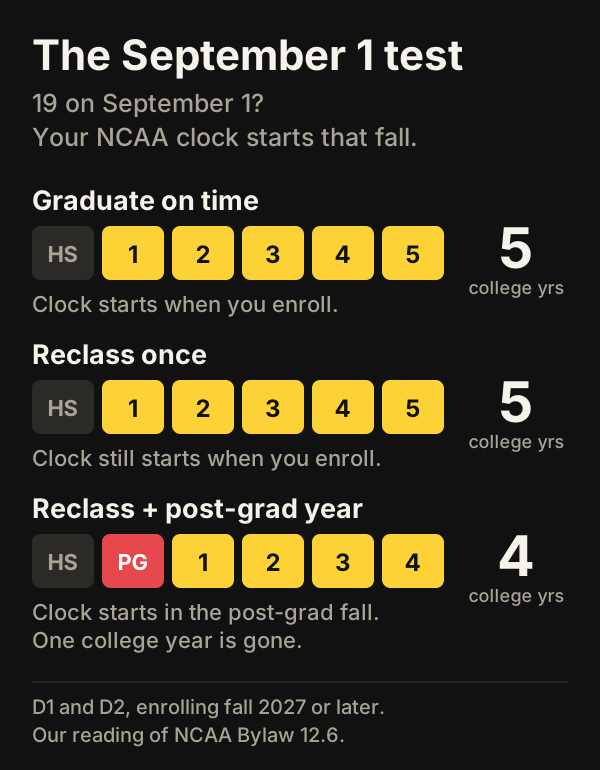
Division I adopted an age-based eligibility model on June 23, 2026, and Division II followed for 2026-27. You get five years to compete, and the period starts at the earlier of two moments: your first term as a full-time college student, or the start of the academic year after your 19th birthday. If you turn 19 on or after September 1, the age trigger moves to the following fall. Students who first enroll full time in fall 2027 or later are under this rule only.
Put simply: find the first September 1 on which you will already be 19. Your five years start that fall, wherever you are. The old delayed-enrollment grace periods are gone, and the only exceptions are military service, religious missions and pregnancy.
A typical senior graduates at 18 and starts college before that date ever arrives. One reclass year uses up the cushion. A second extra year, such as a post-grad year on top of a reclass, or a reclass for an athlete who was already old for the grade, starts the clock before college does. The NCAA has not published reclass examples, so the table below is our reading of the rule. Confirm your own dates with the NCAA Eligibility Center before you decide.
| Athlete | When the five years start | College years lost |
|---|---|---|
| On-age senior, graduates at 18 and enrolls that fall | At enrollment | None |
| Reclassed down one year, enrolls the fall after graduating | That same fall, at enrollment | None |
| Reclassed down one year, then a post-grad or gap year | The fall of the post-grad year | One |
| Already old for the grade, then reclassed down (19 before September 1 of senior year) | The fall of senior year of high school | One, and most states would rule the athlete too old to play as a senior |
| Reclassed up, enrolls full time at 17 | At enrollment | None; the five years start a year sooner |
State rules: age limits and the eight-semester clock
Every state association sets its own limits. These five show the pattern: an age cutoff around 19, and eight semesters that start in 9th grade. Read your own state handbook before you repeat a grade.
Private and prep schools that play outside the state association are not bound by these limits, which is one reason many reclasses come with a school change. The NCAA rules above still apply.
| State | Too old to play if | High school clock | Repeating a middle-school grade |
|---|---|---|---|
| Texas (UIL) | You are 19 or older on September 1 | Four years from first enrolling in 9th grade | A parent-chosen repeat of 7th or 8th grade no longer costs eligibility (since 2023-24) |
| California (CIF) | You turn 19 before June 15 | Eight consecutive semesters from starting 9th grade | The eight semesters start in 9th grade |
| Florida (FHSAA) | You turn 19 before July 1 | Eight semesters from first entering 9th grade | A student repeating 6th, 7th or 8th grade cannot play that year |
| Georgia (GHSA) | You turn 19 before May 1 preceding the school year | Eight semesters from entering 9th grade | No specific rule |
| Pennsylvania (PIAA) | You turn 19 before July 1 | Eight semesters beyond 8th grade | Repeating 8th grade after being promoted starts the eight semesters |
What the numbers say, by sport
- Football: On3 tracked close to 50 blue-chip recruits who skipped their senior year since 2016. Of the 34 who had played a college season, nearly two-thirds logged under 100 snaps as freshmen, and eight of nine reclassified quarterbacks later transferred.
- Basketball: moving up is common at the top. 247Sports counted four of the top 13 recruits in 2021, 10% of the top 50 in 2022 and at least seven of the top 51 in 2023 who had moved up a class. Ranking services place a reclassified player in the new class.
- Baseball: reclassing down is common enough that college coaches rarely treat it as a red flag anymore, according to Prep Baseball Report, but they still ask why.
- No one publishes outcome data for athletes who reclass down. The case for it rests on a year of growth, which is real, and not on evidence that it changes where athletes sign.
How to reclass without breaking a rule
- 1Decide before 9th grade if you can. A repeated 8th grade leaves the NCAA and state eight-semester clocks untouched.
- 2Do the birthday math. Find the first September 1 on which you will be 19, and make sure you are enrolled in college by that fall.
- 3Read your state association handbook for the age cutoff and any rule on repeated grades, and ask the athletic director to confirm in writing.
- 4Map your 16 core courses across the eight semesters with your counselor, including the ten due before senior year.
- 5Update your graduation year in your NCAA Eligibility Center account and on every recruiting profile, and tell coaches directly. They will see the birth date either way.
My take: reclass for development, never for exposure
A reclass buys a year of growth. It does not buy a coach's attention. Most athletes thinking about it are not short on age. They are short on coaches who have seen their film. That problem costs a few hours of email to fix, not a year of tuition.
So I would answer two questions before repeating a grade. First, would another year of size and reps actually move you up a level? If you throw 82 as a young junior, it might. Second, have you put your current numbers in front of enough coaches at the level you fit today? In our platform data, athletes who email 50 or more coaches hear back 82% of the time, and athletes who email fewer than 10 hear back 7% of the time.
If you do reclass, do it once, do it before 9th grade, and check the birthday math first. The age-19 rule turned a second extra year from a free roll into a year of college eligibility.
Email 50 coaches before you add a year
NextCommit builds your coach list, writes a personal email to each coach from your stats and film, sends from your own inbox and tracks every reply. 7-day free trial.
Written by
Adam Paganelli
Co-founder, NextCommit
Adam Paganelli is a co-founder of NextCommit. He played college baseball at Green River College, Sacramento City College, and Northwest Nazarene University after graduating from Tahoma High School in 2018, and he builds the AI outreach, Recruit Score, and coach database tools athletes use on NextCommit.
- Co-founder, NextCommit
- College baseball: Green River College, Sacramento City College, Northwest Nazarene University
- Tahoma High School, Class of 2018
More guides by Adam and the editorial policy.
Sources
Sources for this guide
- NCAA Guide for the College-Bound Student-Athlete, 2026-27 (PDF) Division I: 16 core courses within eight semesters of starting 9th grade, the 10/7 rule, and one extra core course after on-time graduation. Division II: 16 core courses and a 2.2 core GPA.
- NCAA: Division I and II age-based eligibility rules What starts the five-year period, the waivers that were eliminated, and who stays under the previous rules.
- NCAA: Division I adopts age-based eligibility model (June 23, 2026) Five years to compete, the two clock triggers, the waivers that were eliminated and who stays under the previous rules.
- NCAA: Division II adopts age-based eligibility model Division II adopted the same model for 2026-27.
- Texas UIL: eligibility rules Under 19 on September 1 and four years from first enrolling in 9th grade.
- Texas UIL: House Bill 3803 and repeated grades How a parent-chosen repeat of a grade through 8th is treated for eligibility.
- California CIF Bylaws 200 to 206: eligibility requirements (PDF) A student who turns 19 before June 15 is ineligible; eight consecutive semesters from starting 9th grade.
- Florida FHSAA Handbook, 2025-26 (PDF) Age limit of 19 before July 1, eight semesters from first entering 9th grade, and the rule for students repeating grades 6 to 8.
- Georgia GHSA Constitution 2026-27: student eligibility Age limit of 19 before May 1 preceding the school year; eight semesters from entering 9th grade.
- Pennsylvania PIAA Constitution and By-laws (PDF) Age limit of 19 before July 1; eight semesters beyond 8th grade, including a repeated 8th grade after promotion.
- On3: Why reclassifying hurts most blue-chip football prospects (May 2025) Football recruits who skipped senior year since 2016: freshman snap counts and quarterback transfer rates.
- 247Sports: College basketball recruiting reclassification How many top basketball recruits moved up a class in 2021, 2022 and 2023.
- Prep Baseball Report: Recruiting Essentials, reclassing How college baseball coaches view players who reclass down.
FAQ
Reclassifying questions families ask
What does reclass mean in sports?
It means an athlete changed graduation year. Reclassing down means repeating a grade and graduating a year later, usually to gain a year of size and skill. Reclassing up means finishing high school a year early to enroll in college sooner. Recruiting sites then list the athlete in the new class.
What does it mean to reclassify to the class of 2027?
Your graduation year becomes 2027. That is a move down if you were in the class of 2026 and a move up if you were in the class of 2028. College coaches and ranking services will then recruit and compare you with 2027 graduates.
What grade should you reclass in?
Before you start 9th grade, usually by repeating 8th. Division I counts only the core courses from your first eight semesters after starting 9th grade, and state associations also start their eight-semester clock in 9th grade. Check your state first: Florida and Pennsylvania both have rules about repeated middle-school grades.
Is reclassing in high school worth it?
Sometimes, for development or academics. An extra year of growth is real. It does not get you recruited by itself, and it carries costs: tuition if it means private school, a possible lost senior season under state age limits, and a year of NCAA eligibility if you end up too old under the age-19 rule.
Can you reclassify two years?
No rule names a limit, but two years rarely survives the age rules. Most states make you ineligible for high school sports once you are 19 before a set date, and the NCAA five-year period starts the fall after your 19th birthday even if you are still in high school.
Does reclassifying affect NCAA eligibility?
It can, in two ways. Repeating a grade after you start 9th grade breaks the Division I rule that your 16 core courses come from your first eight semesters. And under the age-based rule adopted in June 2026, your five years start the academic year after you turn 19 whether or not you have enrolled in college.
Why are so many kids reclassing?
Families want another year of physical development before coaches evaluate their athlete, and club and private-school programs make it easy to arrange. In basketball the trend runs the other way: top recruits move up a class to reach college and the draft sooner.
How do you reclassify?
It is a school decision, not an NCAA process. Get approval from the school that will enroll you in the repeated or accelerated grade, read your state association age and semester rules, map your 16 core courses, update your graduation year in your NCAA Eligibility Center account, and tell every coach you are talking to.