The short answer: what JUCO means
JUCO is short for junior college: a two-year community college. In recruiting, "going JUCO" means playing one or two seasons at a two-year school, then transferring to a four-year program in the NCAA or NAIA with the credits and the film you built there.
Three associations run junior college sports in the United States. Which one a college belongs to decides what scholarships it can offer and which rules you play under.
| Association | Where | Colleges | Athletic scholarships |
|---|---|---|---|
| NJCAA | Nationwide, in 24 regions | More than 500 | Yes in Division I and II; none in Division III |
| 3C2A (the California Community College Athletic Association) | California | More than 100 | None |
| NWAC | Washington, Oregon and British Columbia | 37 | Set by the conference; ask each college |
JUCO scholarships: what each NJCAA division can offer
The NJCAA splits its colleges into three divisions by how much athletic aid they give. A Division I college can pay tuition, fees, room and board, books, up to $250 in course supplies and one trip home a year. A Division II college can pay tuition, fees, books and up to $250 in supplies, but not housing. Division III colleges give no athletic aid.
A college picks its division sport by sport, so the same school can be Division I in baseball and Division II in basketball. The number of players a team can sign to an NJCAA Letter of Intent is the same in every division.
- You can sign an NJCAA Letter of Intent once you have finished your junior year of high school.
- The letter covers one academic year, August 1 to July 31.
- California community colleges do not offer athletic scholarships, so compare the tuition bill there with a scholarship offer elsewhere.
| Sport | NJCAA Letters of Intent per team (2026-27) | Earliest signing date |
|---|---|---|
| Baseball | 30 | November 1 |
| Softball | 24 | November 1 |
| Football | 85 | February 3 |
| Men's basketball | 15 | November 1 |
| Women's basketball | 15 | November 1 |
| Soccer | 24 | November 1 |
| Volleyball | 14 | November 1 |
Who can play JUCO, and for how long
That open door is the point. Athletes who missed the NCAA core GPA, who were hurt as juniors, or who grew late can start playing college games right away.
- You need proof of high school graduation or a state equivalency exam. There is no core-course or core GPA requirement to play in the NJCAA.
- You must be enrolled full time, which means at least 12 credit hours.
- You get two seasons per sport. Playing in any part of an official game uses a season.
- To play a second season you need 24 semester hours with a 2.00 GPA.
Do JUCO years count against your NCAA eligibility?
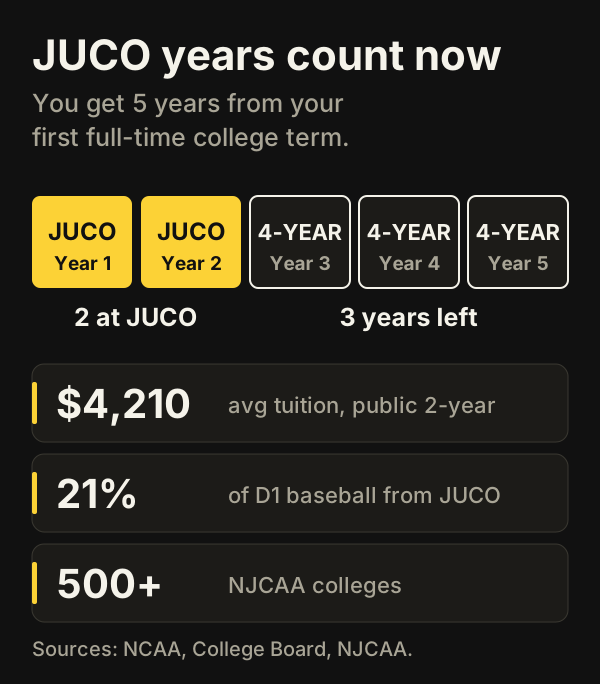
Yes. Under the age-based model Division I adopted in June 2026 and Division II adopted for 2026-27, you get five years to compete. The period starts with your first full-time term at any college, including a two-year college, or the academic year after you turn 19, whichever comes first. It keeps running while you are at a junior college. Two JUCO years leave three.
This is the question most pages get wrong, because the answer changed twice. In December 2024, Vanderbilt quarterback Diego Pavia won a court order arguing that his junior college seasons should not count against his NCAA eligibility. The NCAA then waived the rule for the 2025-26 year only. The 2026 age-based model replaced the old season count altogether: it does not count seasons anywhere, it counts years from the day the clock starts.
Athletes who first enrolled before fall 2027 get whichever rule set gives the better outcome. Students who first enroll full time in fall 2027 or later are under the five-year rule only.
Transferring from JUCO to a four-year program
The rules depend on whether you were an NCAA qualifier out of high school, which means you met the core-course and core GPA standard. Division I simplified its two-year transfer rules in June 2026, effective for 2026-27.
- Baseball, basketball and softball players who transfer to Division I at midyear cannot play until the next academic year.
- Take classes that transfer. Ask the four-year compliance office which of your credits count toward a degree there before you register each term.
- Baseball leans on this route more than any sport: 21% of Division I baseball players in the NCAA's 2020-21 count had transferred from a two-year college, compared with 15% in men's basketball and 8.3% in FBS football.
| Transferring to | If you were a qualifier out of high school | If you were not |
|---|---|---|
| NCAA Division I (2026-27) | One full-time term at the junior college and a 2.000 GPA | Graduate from the junior college with 6 semester hours of English, 3 of math and 3 of science, and a 2.000 GPA |
| NCAA Division II (2025-26 guide) | A 2.2 GPA and an average of 12 transferable credits per full-time term | The same, plus 6 hours of English, 3 of math and 3 of science |
| NAIA | No sit-out year for transfers; some conferences add their own rules | Same |
What JUCO costs
The average published tuition and fees at a public two-year college are $4,210 for 2026-27, according to the College Board. A public four-year college averages $12,290 for in-state students, and a private four-year college averages $46,350.
Two years at community college prices, with or without athletic aid, is the cheapest way to play college sports and keep a four-year degree on schedule. Housing is the cost to check: not every junior college has dorms, and NJCAA Division II scholarships cannot pay for it.
How JUCO recruiting works
- 1Start in the fall of senior year, not after you run out of four-year options. The first NJCAA signing date is November 1 (February 3 in football), and rosters keep filling through the spring and summer.
- 2Email the head coach with your film, your numbers and your grades. Junior college staffs are small and the head coach makes the call.
- 3Ask where last year's sophomores went. A list of names and four-year schools tells you more than a record or a facility tour.
- 4Ask what the scholarship covers in dollars and whether there is housing.
- 5Once you are on campus, start emailing four-year coaches in your first fall. With a five-year clock running, you do not want to wait for your second spring.
My take: JUCO is two years of games, so pick it by where its players go
I played at two junior colleges, Green River College in Washington and Sacramento City College in California, before finishing at Northwest Nazarene, a Division II school. Neither junior college was in the NJCAA. Green River plays in the NWAC and Sac City in California's 3C2A, which is why the first thing to learn about a junior college is which association it plays in.
JUCO is not a consolation prize. It is two years of playing instead of two years of watching, at a fraction of the price. Bryce Harper, Aaron Rodgers, Cam Newton and Jimmy Butler all played at junior colleges.
What changed is the clock. JUCO used to feel free, and under the five-year rule it is not: two years there leave three. So choose a junior college the way you would choose a job, by where it gets people next. If the coach cannot show you where his last class signed, keep looking.
Email junior college and four-year coaches the same week
NextCommit builds your coach list, writes a personal email to each coach from your stats and film, sends from your own inbox and tracks every reply. 7-day free trial.
Written by
Adam Paganelli
Co-founder, NextCommit
Adam Paganelli is a co-founder of NextCommit. He played college baseball at Green River College, Sacramento City College, and Northwest Nazarene University after graduating from Tahoma High School in 2018, and he builds the AI outreach, Recruit Score, and coach database tools athletes use on NextCommit.
- Co-founder, NextCommit
- College baseball: Green River College, Sacramento City College, Northwest Nazarene University
- Tahoma High School, Class of 2018
More guides by Adam and the editorial policy.
Sources
Sources for this guide
- NJCAA: divisional structure What Division I, II and III colleges may offer in athletic aid.
- NJCAA 2026-27 Sports Procedures Chart (PDF) Letter of Intent limits and signing dates by sport.
- NJCAA Handbook: Bylaws 2026-27 (PDF) High school graduation, full-time enrollment, two seasons per sport, and the 24 hours and 2.00 GPA needed for a second season.
- NWAC: about the Northwest Athletic Conference 37 community colleges in Washington, Oregon and British Columbia; the three two-year associations (NWAC, 3C2A and NJCAA).
- 3C2A (California Community College Athletic Association): about More than 28,000 athletes at California community colleges.
- 3C2A Constitution and Bylaws 2026-27 Bylaw 2: recruiting and subsidizing rules. California community colleges do not award athletic scholarships.
- NCAA: Division I age-based eligibility rules The five-year period starts with full-time enrollment at any college, including a two-year college.
- NCAA: Division I and II age-based eligibility rules What starts the five-year period, the waivers that were eliminated, and who stays under the previous rules.
- NCAA Division I Manual 2026-27 (Legislative Services Database) Bylaw 14.5.4, revised June 24, 2026 for fall 2026 and after. Qualifiers: one full-time term and a 2.000 GPA. Non-qualifiers: graduate from the two-year college with 6 semester hours of English, 3 of math and 3 of science and a 2.000 GPA. Bylaw 14.5.4.1.1: midyear transfers in baseball, basketball and softball.
- NCAA: two-year college transfer guide (PDF) Division II two-year transfer requirements (2025-26 edition).
- ESPN: NCAA grants waiver to former junior college players after the Pavia injunction The December 2024 injunction and the one-year waiver for 2025-26.
- College Board: Trends in College Pricing highlights Average published tuition and fees for 2026-27 by sector.
- NCAA Research: transfer composition of Division I teams (PDF) Share of Division I athletes who transferred in from two-year colleges, by sport (2020-21).
FAQ
JUCO questions families ask
What does JUCO mean?
JUCO means junior college, a two-year community college. In sports it refers to teams in the NJCAA, California's 3C2A and the Northwest's NWAC. Athletes usually play one or two seasons, earn credits or an associate degree, and transfer to a four-year program.
Can JUCO schools give athletic scholarships?
Many can. NJCAA Division I colleges can cover tuition, fees, room and board, books and one trip home a year. NJCAA Division II colleges can cover tuition, fees and books. NJCAA Division III colleges and California community colleges give no athletic scholarships.
Do JUCO years count against NCAA eligibility?
Yes, under the age-based rule Division I and II adopted in 2026. Your five years start with your first full-time term at any college, including a two-year college, and keep running. Two years at a junior college leave three at an NCAA school.
Is NAIA JUCO?
No. The NAIA is an association of four-year colleges and universities with its own scholarships and eligibility rules. JUCO refers to two-year colleges in the NJCAA, 3C2A and NWAC.
Is JUCO better than D3?
They solve different problems. JUCO costs less, can offer athletic scholarships and keeps a path to Division I or II open after one or two seasons. Division III is a four-year degree at one school with no athletic aid, though 80% of its athletes get other aid. Pick by cost after aid, playing time and where you want to finish.
What is JUCO level basketball?
Two-year college basketball in the NJCAA, 3C2A or NWAC. NJCAA teams can sign up to 15 players to Letters of Intent. Many players are Division I talents who needed grades, exposure or a year of development, which is why four-year coaches recruit junior college games closely.
Can you go from JUCO to D1?
Yes. From 2026-27, an athlete who was an NCAA qualifier out of high school needs one full-time term at the junior college and a 2.000 GPA to transfer to Division I. A non-qualifier must graduate from the junior college with set English, math and science credits and a 2.000 GPA.
How many years can you play JUCO?
Two seasons per sport in the NJCAA, and playing in any part of a game uses one. To play a second season you need 24 semester hours with a 2.00 GPA.