The short answer: what each step is worth
A verbal offer is a coach telling you he has a spot for you. A verbal commitment is you telling the coach you will take it. Both are promises, and the NCAA is explicit that neither binds the athlete or the school.
What binds a school changed in October 2024, when the National Letter of Intent was eliminated. The official commitment is now a signed athletics aid agreement. At schools that share revenue with athletes there can also be a second document, which the Division I manual calls a settlement-related benefits agreement, signed on the same dates.
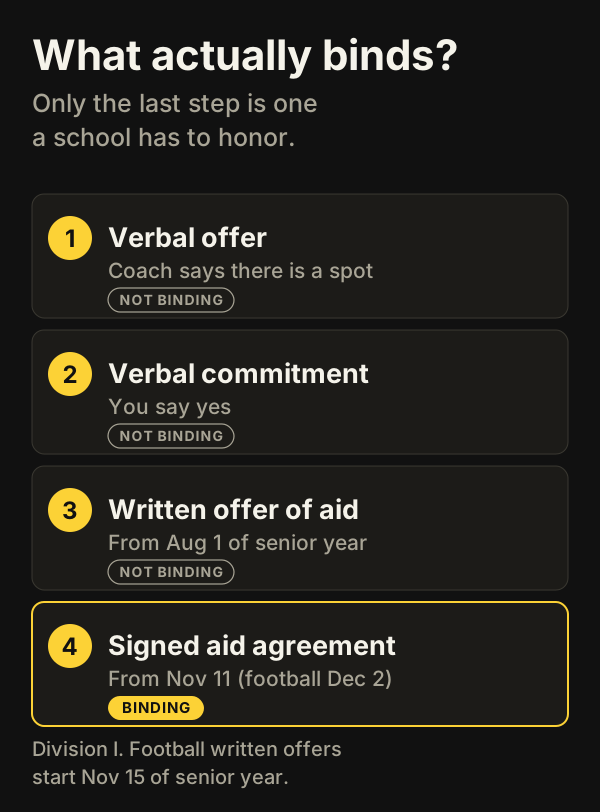
| Step | Who says it | Binding? | Earliest it can happen in Division I |
|---|---|---|---|
| Verbal offer | Coach | No | When coaches can first call or message you in your sport (see the next section) |
| Verbal commitment | Athlete | No | Any time after an offer |
| Written offer of athletics aid | School | Not until you sign | August 1 of senior year; November 15 of senior year in football |
| Signed athletics aid agreement | Athlete and school | Yes | November 11, 2026 in most sports; December 2, 2026 in football |
When coaches can make a verbal offer, by sport
Only men's ice hockey has a Division I rule on verbal offers themselves (August 1 before junior year). In every other sport the practical limit is the first date a coach can call or message you.
Division II coaches can call, text and email at any time and meet you off campus from June 15 before junior year. Division III coaches can contact you at any time, but have no athletic aid to offer.
These dates limit coaches, not you. You can email a coach at any age, and an early email is how you end up on the list a coach calls on the first day.
| Sport (Division I) | First date coaches can call or message you |
|---|---|
| Most sports, including soccer, volleyball and track and field | June 15 after sophomore year |
| Women's basketball | June 1 after sophomore year |
| Baseball | August 1 before junior year |
| Softball | September 1 of junior year |
| Football and men's basketball | June 15 after sophomore year, but coaches can take your call, host unofficial visits and talk at their camps earlier, so offers come at any age |
Get every contact date for your sport
The 2026-27 NCAA recruiting calendar covers first-contact dates, contact, quiet and dead periods, and every signing window.
Types of offers you will hear
Apart from preferred walk-on, these are recruiting slang, not NCAA terms. Ask what the coach means.
- Committable offer: the staff would take your commitment today.
- Non-committable offer: real interest, but the coach is waiting on other recruits, a roster spot or more film before he will accept a commitment.
- Preferred walk-on: a roster spot with no athletic scholarship. The NCAA defines a preferred walk-on as an athlete with a guaranteed spot and no athletics aid.
- Grayshirt offer: a spot that starts in January instead of the fall.
- Camp offer: a verbal offer made at a school's camp. It is worth exactly what any verbal offer is worth.
How often verbal commitments break
Often enough to plan for. 247Sports counted 327 decommitments among the 1,738 football recruits who committed to Power Four programs in the 2024 class, which is 18.8%.
It runs both ways. Roster limits at House settlement schools, such as 105 in football, 34 in baseball, 28 in soccer, 25 in softball and 18 in volleyball, gave coaches a hard number to fit under, and some verbal offers did not survive it. ESPN reported that a Penn State women's soccer commit had her offer withdrawn in August 2024 as the 28-player limit approached.
The protection starts at the signature. Once you sign an athletics aid agreement, other schools must stop recruiting you, and the aid in it cannot be reduced or cancelled for performance, injury or other athletic reasons during its term.
What to ask when a coach makes a verbal offer
Then follow up by email the same day, thanking the coach and repeating the terms as you understood them. It is not a contract, but it is a record, and it shows the coach how you will handle things as a player.
- 1Is this a committable offer today, or are you waiting on something?
- 2Is there athletic aid in it? How much, in dollars or as a share of the cost of attendance, and for how many years?
- 3Will I be on the roster you submit, or competing for a spot until the roster deadline?
- 4How long does the offer stand, and when would I get the written offer of aid?
- 5How many players at my position are you taking in this class, and how many are committed?
- 6If the staff changes before I sign, what happens to this offer?
After you commit
- Tell the other coaches who were recruiting you, personally and quickly. You may need those relationships again.
- Keep your grades and your Eligibility Center account on track. An offer cannot survive a missed core-course requirement.
- Keep sending the staff updates through your season.
- Put the first signing date for your sport on the calendar and ask the coach in October when your paperwork will arrive.
My take: celebrate the offer, keep your inbox warm
A verbal offer is a coach showing you his plan in pencil. I would celebrate it, post it and thank him. I would not treat it as finished until the athletics aid agreement is signed.
That does not mean shopping a commitment around. It means staying on good terms with the coaches who recruited you, answering their emails honestly and never burning one. When a staff gets fired in December or a transfer takes your spot, the recruits who land well are the ones with three coaches who still pick up.
If you do not have an offer yet, the fix is volume and fit. In our platform data, athletes who email 50 or more coaches hear back 82% of the time, and 81% of coach replies arrive within a week. Offers start as replies.
Start the conversations that turn into offers
NextCommit builds your coach list, writes a personal email to each coach from your stats and film, sends from your own inbox and tracks every reply. 7-day free trial.
Written by
Adam Paganelli
Co-founder, NextCommit
Adam Paganelli is a co-founder of NextCommit. He played college baseball at Green River College, Sacramento City College, and Northwest Nazarene University after graduating from Tahoma High School in 2018, and he builds the AI outreach, Recruit Score, and coach database tools athletes use on NextCommit.
- Co-founder, NextCommit
- College baseball: Green River College, Sacramento City College, Northwest Nazarene University
- Tahoma High School, Class of 2018
More guides by Adam and the editorial policy.
Sources
Sources for this guide
- NCAA Guide for the College-Bound Student-Athlete, 2026-27 (PDF) Verbal commitments are not binding on the athlete or the school; definitions of preferred walk-on and the Division III celebratory signing form.
- NCAA: Division I Council approves changes, including ending the National Letter of Intent (October 9, 2024) Written offers of athletics aid replaced the letter of intent; once one is signed, other schools must stop recruiting the athlete.
- NCAA Division I Manual 2026-27 (Legislative Services Database) Bylaw 13.02.13 (athletics aid agreement and settlement-related benefits agreement), Bylaws 13.1.3.1 and 13.1.3.2 (first permitted calls by sport), Bylaw 13.9 (offers), Bylaw 15.3.4.2 (aid cannot be reduced for athletic reasons) and Bylaw 17.2 (roster limits).
- NCAA: 2026-27 Division I signing dates (PDF) Signing dates for football, basketball and all other sports.
- NCAA: 2026-27 Division II recruiting guide (PDF) Division II contact rules.
- NCAA: Division I Board of Directors adopts changes to roster limits (June 23, 2025) Roster limits at participating schools and protections for athletics aid.
- 247Sports: college football decommitments in the 2024 recruiting class 327 of 1,738 Power Four football commits in the 2024 class decommitted.
- ESPN: college athletes face signing day amid uncertainty over new roster limits Verbal offers withdrawn because of roster limits, including a Penn State women's soccer commit in 2024.
FAQ
Verbal commitment questions families ask
Is a verbal commitment binding?
No. The NCAA says a verbal commitment is not binding on the athlete or the school. Either side can change its mind until the athlete signs a written athletics aid agreement.
Can you break a verbal commitment?
Yes. You can decommit, and a coach can withdraw a verbal offer. About 19% of Power Four football commits in the 2024 class decommitted, according to 247Sports. Tell the coach directly and promptly if you change your mind.
How early can you verbally commit?
There is no NCAA rule on when an athlete can commit. The limit is on when a coach can talk to you. In most Division I sports coaches cannot call or message recruits until June 15 after sophomore year, with later dates in baseball and softball, so that is when most offers start.
What is a D1 offer?
A Division I coach telling you there is a roster spot for you, with or without athletic aid. Until it is a written offer of athletics aid, which can come from August 1 of senior year in most sports, it is a verbal offer and is not binding.
What is a committable offer?
Recruiting slang for an offer the staff would accept your commitment on today. Some verbal offers are closer to strong interest: the coach wants you, but is waiting on other recruits or roster spots. The term has no NCAA definition, so ask the coach directly.
Does a verbal offer guarantee a scholarship?
No. A verbal offer may not include any athletic aid. Ask what the offer is in dollars or as a share of the cost of attendance, and whether it will be in your athletics aid agreement.
Can a coach pull a verbal offer?
Yes, for any reason: a coaching change, a transfer, another recruit committing first, or a roster limit. Once you sign an athletics aid agreement, the aid cannot be reduced or cancelled for athletic reasons during its term.
Can you verbally commit to a D3 school?
Yes, but Division III has no athletic aid and no letter of intent, so the commitment is only real once you are admitted and deposit. Many Division III recruits apply Early Decision with the coach's support.