The short answer, level by level
Division III schools give no athletic scholarships. Division II schools do, from a fixed pool per sport that coaches split into partial awards. The label matters less than it sounds: most Division III athletes get academic or need-based aid, and most Division II athletes get a partial award that leaves a bill.
| Level | Athletic scholarships? | How the money works in 2026-27 |
|---|---|---|
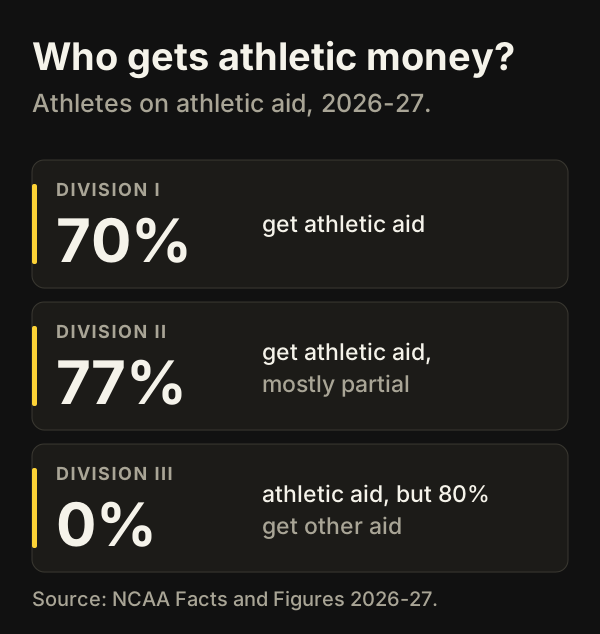
| NCAA Division I | Yes | No NCAA scholarship caps at House settlement schools, which have roster limits instead. 70% of athletes receive athletics aid |
| NCAA Division II | Yes, mostly partial | A fixed number of full-scholarship equivalents per sport, split across the roster. 77% of athletes receive athletics aid |
| NCAA Division III | No | Merit and need-based aid only. 80% of athletes receive non-athletics aid |
| Ivy League (Division I) | No | Need-based aid only, by league rule |
| NAIA | Yes, mostly partial | A fixed limit per sport, split across the roster |
| Junior college | Depends | NJCAA Division I and II yes, Division III and California no |
What the Division III rule bans, and what it allows
Division III Bylaw 15.01.3 says a school cannot award financial aid to any student on the basis of athletics leadership, ability, participation or performance. Bylaw 15.01.7 goes further and bars schools from setting aside aid funds or quotas for athletes.
Everything else is allowed. A Division III athlete can receive merit scholarships, need-based grants and outside awards on the same terms as any other student. The NCAA checks this every year: its Financial Aid Reporting Program compares the aid packages of athletes with those of other students at each school and reviews the schools where athletes come out ahead.
So there is no such thing as an "athletic leadership scholarship" at a Division III school, and a coach cannot add money to your package. What a coach can do is tell admissions he wants you.
How Division III athletes actually pay for college
About 80% of Division III schools are private, and private colleges rarely charge the sticker price. The average published private tuition is $46,350 for 2026-27, according to the College Board, but private nonprofit colleges discounted first-year tuition by an average of 57.1% in NACUBO's tuition discounting study, and about 90% of their first-year students received institutional aid.
For a Division III recruit, grades are the scholarship. The merit award is set by your GPA, your course rigor and sometimes your test scores, and the need-based grant is set by your family's finances.
- 1Run the net price calculator on each school's website before the first visit.
- 2Ask the coach for an academic pre-read. Admissions looks at your transcript early and tells the coach whether you are admissible.
- 3Ask the financial aid office for an estimate before you apply. NESCAC schools, for example, say their aid offices can give estimates before admission.
- 4If the coach asks you to apply Early Decision, get the aid estimate first. Early Decision is binding, and it removes your ability to compare offers.
- 5Compare the bottom line across levels: tuition, housing and fees, minus every grant and scholarship.
What a D3 coach can offer, and what "committing" means
- A roster spot and support with admissions. Coaches cannot promise admission; the admissions office decides.
- Contact at any time by call, text or email, in-person contact off campus after you finish sophomore year, and official visits from January 1 of junior year.
- No letter of intent. Division III bans them. After you are admitted you can sign an optional celebratory form, which is not binding.
- A Division III commitment becomes real when you are admitted and pay your deposit, which is why Early Decision is so often part of the conversation.
Division II: partial scholarships from a fixed pool
Every Division II sport is an equivalency sport. Each team has a set number of full-scholarship equivalents, and the coach divides them however he wants. A baseball coach with 9 equivalencies and 40 players is handing out quarters and thirds, not full rides.
In 2024 the median athletics aid per Division II athlete was about $6,200 at schools with football and $7,800 at schools without it. Most Division II athletes stack that with academic and need-based aid.
| Sport | Division II scholarship equivalents per team |
|---|---|
| Football | 36 |
| Baseball | 9 |
| Softball | 7.2 |
| Men's basketball | 10 |
| Women's basketball | 10 |
| Men's soccer | 9 |
| Women's soccer | 9.9 |
| Women's volleyball | 8 |
| Track and field with cross country | 12.6 |
See every level's limits in one place
Division I roster limits at House settlement schools next to the Division II, NAIA and NJCAA scholarship limits for every sport.
Is any of this changing?
Division I already changed. Since July 1, 2025, schools in the House settlement have roster limits instead of scholarship limits, and can put as many rostered athletes on aid as they choose. Division II and III were not part of that change.
A proposed class action filed in October 2026 challenges the Division III scholarship ban. There is no ruling, and nothing is different for the class of 2027. Plan on the rules above.
My take: stop asking who gives athletic money and ask what you would pay
I finished my career at a Division II school, and I think families ask the wrong question when they ask whether a level "gives scholarships." A 25% baseball scholarship at a $40,000 school leaves you $30,000 a year. A Division III school with a strong merit award can beat that without a dollar of athletic money.
Get every school to the same line: what do we pay per year after all aid, and for how many years is that number guaranteed? Then compare that with where you would actually play.
And if Division III is in the picture, treat the classroom like a showcase. A 3.8 moves your price more than three miles an hour does.
Get real offers from more than one level
NextCommit builds your coach list, writes a personal email to each coach from your stats and film, sends from your own inbox and tracks every reply. 7-day free trial.
Written by
Adam Paganelli
Co-founder, NextCommit
Adam Paganelli is a co-founder of NextCommit. He played college baseball at Green River College, Sacramento City College, and Northwest Nazarene University after graduating from Tahoma High School in 2018, and he builds the AI outreach, Recruit Score, and coach database tools athletes use on NextCommit.
- Co-founder, NextCommit
- College baseball: Green River College, Sacramento City College, Northwest Nazarene University
- Tahoma High School, Class of 2018
More guides by Adam and the editorial policy.
Sources
Sources for this guide
- NCAA Division III Manual 2026-27 Bylaw 15.01.3 (no aid based on athletics) and 15.01.7 (no athletic aid funds or quotas); Bylaws 13.02.10.1, 13.1.1.1 and 13.6.1.1.1 (contact and official visits); Bylaw 13.9.1 (no letter of intent) and 13.9.1.1 (celebratory signing form).
- NCAA: Division III Financial Aid Reporting Program The annual review that compares aid to athletes with aid to other students.
- NCAA Divisional Facts and Figures 2026-27 (PDF) 416 Division III schools and about 210,000 athletes; 80% of Division III athletes receive non-athletics aid; 77% of Division II and 70% of Division I athletes receive athletics aid.
- NCAA Division II Manual 2026-27 Bylaw 15.4.2.1: equivalency limits by sport.
- NCAA: Division II athletics scholarships The partial-scholarship model.
- NCAA Research: Division II revenues and expenses report (PDF) Median athletics aid per athlete in 2024: about $6,200 at football schools and $7,800 at schools without football.
- NCAA: implementation of the House settlement, questions and answers (May 29, 2026, PDF) Division I scholarship limits eliminated at participating schools from 2025-26.
- NESCAC: admissions statement Coaches cannot promise admission; financial aid offices can give estimates before admission.
- NAIA Official and Policy Handbook (PDF) Policy XIII: aid limits by sport.
- College Board: Trends in College Pricing highlights Average published tuition and fees for 2026-27 by sector.
- Higher Ed Dive: tuition discount rate reaches 57% at private nonprofits (NACUBO) Average first-year tuition discount and the share of students receiving institutional aid.
- NCAA Research: estimated probability of competing in college athletics (PDF) Share of high school athletes who go on to play Division III, by sport.
- Straight Arrow News: Division III athletes sue the NCAA over the scholarship ban Proposed class action filed in October 2026. No ruling as of November 9, 2026.
FAQ
D3 and D2 scholarship questions families ask
Do D3 schools give athletic scholarships?
No. Division III Bylaw 15.01.3 bans any financial aid based on athletics leadership, ability, participation or performance. Division III athletes are packaged like every other student, and the NCAA reports that 80% of them receive non-athletics aid.
Does D2 give athletic scholarships?
Yes. Every Division II sport has a set number of full-scholarship equivalents that coaches split across the roster, such as 9 in baseball and 36 in football, so most awards are partial. The NCAA reports that 77% of Division II athletes receive some athletics aid.
Do D2 schools give full rides?
Rarely. A Division II coach can give one player a full scholarship, but it comes out of a small team pool. The median athletics aid per Division II athlete was about $6,200 at schools with football and $7,800 at schools without it in 2024, so plan on a partial award combined with academic aid.
Do D3 schools recruit?
Yes, actively. Division III coaches can call, text and email at any time, meet you off campus once you finish sophomore year, and host official visits from January 1 of junior year. What they offer is support in admissions and a roster spot, not athletic money.
When can you commit to a D3 school for sports?
Whenever you and the coach agree, but the commitment is only real once you are admitted and deposit. Division III has no letter of intent. Many recruits apply Early Decision with the coach's support and can sign an optional, non-binding celebratory form after they are admitted.
Is it better to go D3 or NAIA?
Compare the bill and the role. NAIA teams can give athletic scholarships from a fixed pool per sport, and Division III teams cannot. A Division III school with a large merit award can still cost less than an NAIA school with a small athletic one. Ask both for the full aid offer in writing.
Can D3 athletes get NIL money?
Yes. Division III athletes can be paid for the use of their name, image and likeness. The payment cannot be for playing or a reward for enrolling at a school.
How rare is it to play D3?
About 3.5% of high school baseball players, 2.6% of football players, 2.5% of softball players and 1.5% of boys basketball players go on to play in Division III, according to NCAA research. It is the largest NCAA division, with 416 schools and about 210,000 athletes.